
Protecting Your Cards for Dummies
August 22, 2026
The Ultimate Guide to Collecting Card Protections (Sports & TCG)
Whether you collect NBA, Football, Baseball or Pokémon cards, protecting your gems is essential. A simple scratch or a slightly dinged corner can cause a card's value to drop by 50 to 80%.
Between sleeves, toploaders and one-touch, it can sometimes be difficult to navigate. Here's the complete guide to understanding thicknesses, choosing the right protection, and selecting the best brands.
1. The 3 main levels of protection
Protective materials are organized into three main categories depending on the use and value of your cards:
Soft Sleeves (Soft / Penny Sleeves): First-line protection. They create a physical barrier against dust, fingerprints, and micro-scratches on delicate surfaces (Prizm, Chrome, Optic). No card should ever be handled or stored without a sleeve.
Semi-rigid Holders (Semi-rigids / Card Savers): Semi-flexible plastic cases that hold the card flat without compressing it. This is the mandatory format required by grading companies (PSA, Beckett/BGS, SGC, PCA) for sending your cards.
Rigid Holders (Toploaders, One-Touch & Beskard): The ultimate hard cases. Toploaders are the standard for trading, selling, and storing. Magnetic cases (One-Touch) offer maximum protection and the best display for your biggest showcase pieces (1-of-1, RPA, on-card autographs).
2. Sleeve Formats and Types
For sports cards, the choice of soft sleeve must be meticulous:
Standard Penny Sleeves: Perfect for 35pt to 55pt cards.
Thick Sleeves: Specially cut with a wider tolerance to accommodate 75pt to 360pt cards without bending corners during insertion.
Perfect Fits: Designed to fit snugly around the card. This prevents the card from sliding or rubbing against the inner walls of the sleeve. Very often used in One-Touches and Toploaders.
Team Bags: Large plastic pouches with a reusable adhesive strip. The toploader or One-Touch is slipped into it to prevent the hard plastic from scratching during storage or transport.
3. Solid Protections: Toploaders, One-Touch, and Beskard
When a card increases in value or is a hit (autograph, 1-of-1, patch), a simple soft sleeve is no longer enough. You need to switch to rigid protections ("hard cases") to prevent the card from bending, getting damaged, or deteriorating due to light exposure.
Here is a comparison of the three essential solid solutions:
A. Toploaders (The Collector's Standard)
The toploader is the most common semi-rigid to rigid plastic case (generally made of PVC) in the world.
How it works: The card, previously inserted into a penny sleeve, is slipped in from the top.
Strengths: Very affordable, lightweight, easy to stack and store in storage boxes (like Carbonite). It's the standard for sales, Vinted/eBay trades, and postal shipping.
Weaknesses: The card remains exposed to dust through the top opening (hence the importance of using a Team Bag over it) and the plastic can scratch over time.
Popularized by brands like Ultra PRO, BCW, or Ultimate Guard, these rigid hard plastic cases are composed of two parts held together by a central magnet.
How it works: The card is laid flat in a custom-molded cavity (available in 35pt, 55pt, 75pt, 100pt, 180pt, etc.), then closed with a click by the magnet.
Strengths: Very elegant visual appeal, ideal for display in a showcase. Most models include UV protection to prevent felt signatures or colors from fading in the sun.
Golden Rule: To prevent the card's surface from moving or rubbing against the cavity, use a Perfect Fit Sleeve specially cut for One-Touch under the card.
C. The Beskard by Cardslabel (The high-end Made in France alternative)
The Beskard created by Cardslabel is a recent innovation in ultra-resistant polycarbonate that is shaking up the market.
How it works: Unlike the magnetic One-Touch, the Beskard uses a "Secure Lock" clip-on closure system. It has a top slot for inserting a custom label.
Strengths:
Polycarbonate & Scratch-resistant: Much more robust and crystalline material than classic PVC.
Graded Look without the Grade: Allows for a visual result similar to a professional grading case (PSA, BGS) thanks to the customizable label (player name, year, 1-of-1 print run, team logo, etc.).
UV Protection & Hold: Anti-UV, stackable, and very securely sealed.
Disadvantages: More expensive than a classic toploader, it is mainly intended for your favorite cards, autographs, and display pieces.
Comparative table of solid protections:
Case Type | Closure Type | Main Material | UV Protection | Custom Label | Best Use |
Top-loading slot | Rigid PVC | No | No | Shipping, transactions, bulk storage | |
Central magnet | Molded plastic | Yes | No | Showcase display, high-value cards | |
Clip-on "Secure Lock" | Polycarbonate | Yes | Yes | Display, centerpiece items |
4. Card Thickness: Mastering the PT (Points) System
Unlike classic game cards, which all have the same thickness, sports cards vary greatly. A base card is nothing like a card containing a piece of jersey, ball, or baseball bat.
Thickness is measured in PT (1/1000th of an inch):
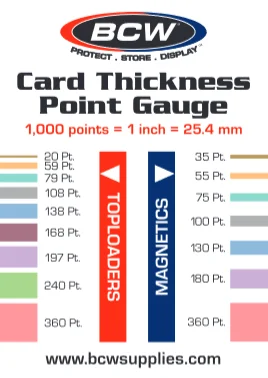
Thickness (PT) | mm Equivalent | Types of Sports Cards |
35 pt | ~0.9 mm | Base cards, thin Inserts, standard Prizm, Optic, Topps Chrome cards |
55 pt - 75 pt | ~1.4 to 1.9 mm | Thicker cardboard cards, Premium inserts (Simple Autographs) |
100 pt - 130 pt | ~2.5 to 3.3 mm | Cards with thin jersey pieces and premium collections (Flawless, Obsidian) |
180 pt | ~4.5 mm | Large complex jersey pieces, Sneaker cards (shoe pieces), Logoman |
240 pt to 360 pt | ~6.0 to 9.0 mm | Ultra-thick relics (bat pieces, ball leather, Booklets) |
5. Protection Materials: PP vs PVC
The plastic used makes all the difference in preserving the value of your collection long-term:
Polypropylene (PP) — Safe for cards: This is the material used for soft sleeves. Guaranteed acid-free and PVC-free, these sleeves do not release any chemical compounds. They prevent the plastic from "sticking" to the glossy surface of a Chrome card or causing autograph ink to bleed over the years.
Rigid PVC — Use with caution: Toploaders and semi-rigid holders are made of PVC to provide essential rigidity. The absolute rule in the hobby: never put a bare sports card in a PVC toploader. Direct friction from rigid PVC risks creating micro-scratches on the surface or altering the signature. Always slide the card into a PP penny sleeve first.
UV protection (One-Touch or Beskard): Felt signatures (on-card or sticker autographs) and sports card colors fade very quickly under sunlight. Prioritize high-end magnetic cases that incorporate UV treatment for displaying your best hits.
Summary: Which protection for your card?
Type of Sports Card | Recommended Protection |
Base / Common Card | Standard penny sleeve + cardboard storage box (Carbonite type) |
Rookie / Numbered / Parallel Card | Penny sleeve + 35pt Toploader |
Thick Jersey / Patch Card | Thick Penny Sleeve + Correct size Toploader (75pt to 180pt) |
Big Hit / Autograph / Rare Patch / 1-of-1 | Perfect fit sleeve + One-Touch or Beskard (with UV filter) + Team Bag |
Card intended for Grading (PSA/BGS) | Penny sleeve + Semi-rigid (Card Saver 1) |